The question arrives unbidden, usually at the worst possible time. Stay or go. Carry on or change. Double down or walk away. When you are in the middle of a major life transition, the mind has a tendency to reduce complex, multi-dimensional situations into a binary — as if there are only ever two paths, and the only task is to summon the courage to choose the right one.
That framing is not neutral. It is a trap. And it is one of the most reliable ways to stay stuck.
Empty space, drag to resize
Key Takeaway
Most people facing a major life decision see two options: the one they have now, and the one they are afraid to take. The Open Map is a framework for expanding that view — deliberately mapping several possible directions before committing to any. The goal is not to find the perfect answer. It is to stop operating from a false binary and make a genuine choice from a fuller picture.
Empty space, drag to resize
Psychologists refer to this as narrow framing — the cognitive tendency to construct decisions as either/or when the actual landscape contains far more possibilities. Research by Chip and Dan Heath, drawing on a large body of decision science, found that professionals facing career and life decisions typically consider only two options at a time, and often arrive at decisions they later regret precisely because they never explored a third or fourth direction.
The two-option trap is especially common during transitions because transitions are inherently uncomfortable. The mind wants resolution. It wants to stop sitting in uncertainty. And two options feel like progress — at least you have defined the problem. What the binary misses is that the real problem may not be a choice between those two options at all.
A professional wondering whether to leave their job or stay in it may be asking the wrong question entirely. The more generative question might be: what specifically is not working, and can that be addressed within the current role, adjacent to it, or only outside it? The moment you ask the broader question, more than two answers become possible.
1 Heath, C., & Heath, D. (2013). Decisive: How to Make Better Choices in Life and Work. Crown Business. Drawing on research from Nutt, P.C. (1993). The formulation processes and tactics used in organisational decision making. Organisation Science, 4(2), 226–251.
Empty space, drag to resize
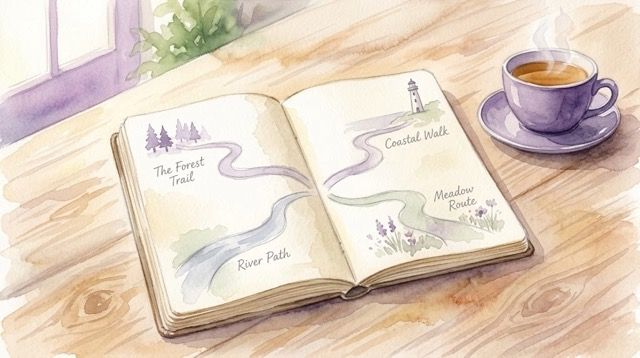
The Open Map is a structured way of sketching multiple possible directions before evaluating any of them. It is not a decision-making tool in the traditional sense — it does not tell you what to choose. It is a direction-mapping tool: a deliberate expansion of the option space before the analytical work of choosing begins.
The process has three stages.
Stage 1 — Generate without filtering. Write down every possible direction you could take in this situation. Include options you have already dismissed. Include options that feel impossible. The goal at this stage is quantity, not quality. Evaluation comes later.
Stage 2 — Cluster and name. Group similar options together and give each cluster a short, honest name. You will usually find three to five distinct directions, even if the list started with fifteen items. Most of the variation was in the details, not the direction.
Stage 3 — Map the conditions, not just the appeal. For each cluster, ask two questions: what would this direction require of me? And what would I have to release to take it? You are not deciding yet. You are building a map that is honest about terrain.
The Open Map is particularly useful at the beginning of a transition, when everything feels urgent and the pressure to decide is high. It slows the process down in a productive way — not to avoid deciding, but to ensure the decision is made from a fuller picture.
Empty space, drag to resize
In practice, most major life transitions can be mapped across four broad directions. The table below uses a career transition as an example, but the same structure applies to relationship decisions, relocation choices, or any other significant life change.
| Direction |
What it looks like |
What it requires |
Worth exploring? |
| Stay & adapt |
Upskill, reposition within your current role or field |
Honest assessment of what is genuinely changeable |
✅ Yes — often the most underexplored option |
| Pivot sideways |
Move into an adjacent field using existing strengths |
Clarity on transferable skills |
✅ Yes — lower risk than a full career change |
| Full career change |
Retrain and restart in a genuinely new area |
Time, financial runway, and tolerance for uncertainty |
✅ Yes — but map the cost honestly first |
| Pause & gather data |
Take a fixed period to explore before committing to any direction |
Permission to not decide yet |
✅ Yes — often the most underrated option |
None of these directions is inherently correct. Each carries genuine costs and genuine possibilities. The purpose of mapping them is not to find the obviously right one — it is to notice which ones you were not considering at all, and ask yourself honestly why.
In many cases, the direction people dismiss most quickly is the one that deserves the most careful examination. The option labelled 'impossible' is often simply the one that requires the most change — from circumstances, from other people, or from a self-image that has not caught up with the current situation.
Empty space, drag to resize
It would be easy to frame the two-option trap as a thinking error — a problem of cognitive technique, solved by a better framework. But that framing misses something important.
The reason most people see two options is not that they lack imagination. It is that the other options feel too uncertain, too exposing, or too much like admitting that the current path has genuinely run its course. The binary is often a protection mechanism. It allows us to frame the decision as someone else's to make — stay until circumstances force us out, or wait until the perfect opportunity announces itself.
Research in positive psychology suggests that the experience of authentic choice — a sense of having genuinely considered and selected from real options — is strongly associated with wellbeing, psychological resilience, and satisfaction with outcomes, even when the outcome itself is difficult. The Open Map is, in part, a way of reclaiming that experience. Of being the person who chose, rather than the person to whom things happened.
This does not mean the fear dissolves. The Open Map does not make decisions easy. It makes them honest. And honest decisions, even difficult ones, tend to sit better over time than decisions made by default.
2 Ryan, R.M., & Deci, E.L. (2000). Self-determination theory and the facilitation of intrinsic motivation, social development, and wellbeing. American Psychologist, 55(1), 68–78.
Empty space, drag to resize
- When facing a major life decision, start by generating at least five possible directions — before evaluating any of them.
- Look closely at the options you dismissed fastest. Ask what made them feel impossible, and whether that assessment is accurate.
- Map what each direction requires — time, money, relationships, identity — not just whether it appeals.
- Separate the mapping stage from the choosing stage. Do not collapse them into one conversation with yourself.
- If you are still seeing only two options after mapping, ask: what would a third direction look like if neither of the current two existed?
Empty space, drag to resize