Jan 13 / Ricky Tam

Life in the UK Test Format Explained: What to Expect in 2026

Introduction

You have finally decided to book your Life in the UK test, but a nagging question keeps surfacing: what exactly will I face when I sit down at that computer? The uncertainty can feel worse than the test itself. Perhaps you have heard conflicting information online, or worry that the format might have changed since your friend took it last year. Take a breath. The test format has remained remarkably stable, and knowing precisely what awaits you is half the battle won.
A minimalist study desk with a laptop showing "Life in the UK" on a calm purple screen, a study handbook, and a cup of tea, representing calm preparation for the Life in the UK test.

The Essential Facts at a Glance

The Life in the UK test consists of 24 multiple-choice questions that you must complete within 45 minutes. To pass, you need to answer at least 18 questions correctly — that is a 75% pass mark. The test is entirely computer-based and takes place at an authorised test centre. Every question comes from the official handbook, Life in the United Kingdom: A Guide for New Residents (3rd Edition). There is no trick to it: prepare thoroughly from the official material, and you give yourself the best chance of success.

A minimalist infographic featuring purple icons of a checklist, a clock, and a target, illustrating the 2026 Life in the UK test format and 45-minute time limit.

Key Format: 24 Questions | 45 Minutes | 75% Pass Mark.

Empty space, drag to resize

Understanding the 24 Questions

Each test session presents 24 questions drawn randomly from a large question bank. This randomisation means that no two tests are identical — your friend's test will have been different from what you will face, and the person sitting next to you at the test centre will see different questions too. Some questions require you to select a single correct answer, whilst others ask you to choose two or more correct responses. Pay close attention to how many answers each question requires; overlooking this detail is one of the most common mistakes candidates make.

The questions cover five broad areas from the official handbook: the values and principles of the UK, British history from ancient times to the present day, the structure of government and law, aspects of everyday life and society, and British culture including arts, sports, and traditions. History questions tend to appear most frequently, though the exact mix varies with each randomly generated test.
Empty space, drag to resize

FREE RESOURCE 

Ready to start preparing?


Our 3-Day Starter Kit gives you:

Test format demystified

The most-tested British Values

Top 10 facts that appear in 80% of tests

Empty space, drag to resize

The 45-Minute Time Allowance

Forty-five minutes sounds generous for 24 questions, and for most candidates it is more than sufficient. That works out to nearly two minutes per question, which allows ample time to read carefully, consider your answer, and review if needed. The computer screen displays a timer so you always know how much time remains. If you have prepared well, you may find yourself finishing in 15 to 20 minutes — and that is perfectly acceptable. You can review and change your answers at any point before submitting the test.
However, if you experience test anxiety, time can feel compressed. If this sounds familiar, consider exploring our guide on Life in the UK Test Anxiety which offers practical strategies from someone who has been through the experience firsthand.
Empty space, drag to resize

The 75% Pass Mark

You must answer at least 18 out of 24 questions correctly to pass. This 75% threshold means you can afford to get up to 6 questions wrong and still succeed. Some candidates find comfort in knowing there is room for error; others feel additional pressure at the thought of any wrong answers. Both responses are entirely normal.
The overall pass rate is approximately 70–80%, meaning roughly three out of four candidates pass. Rather than finding this discouraging, consider it a reminder that proper preparation matters. Those who study systematically from the official handbook tend to perform significantly better than those who rely on guesswork or unofficial question banks. You can learn more about pass rate statistics in our detailed analysis: Life in the UK Test Pass Rate.
Empty space, drag to resize

What Happens at the Test Centre

When you arrive at your test centre, staff will check your identification and booking confirmation. You will then be directed to a computer workstation. Before your timed test begins, you will have a brief practice session with sample questions to familiarise yourself with the interface. This practice period does not count towards your 45 minutes.
The test centre provides headphones if you wish to listen to questions being read aloud — a helpful option if you prefer auditory learning or if English is not your first language. The environment is quiet and supervised. You cannot bring notes, phones, or other materials into the testing room. Once you finish, instructions for receiving your results can vary between centres. While you may be told your result verbally, some staff may instead advise you to wait for a digital notification.

Calm Tip: In many cases, candidates receive an automated SMS or email notification within 10–15 minutes of leaving the building. You can also log into your official Life in the UK account to see your pass status and Unique Reference Number (URN) almost immediately. If you don't hear anything right away, stay calm; the system usually updates before you've finished your journey home. 

Keep your unique reference number (URN) safe; you will need it for your settlement or citizenship application.
Empty space, drag to resize

What You Need to Bring

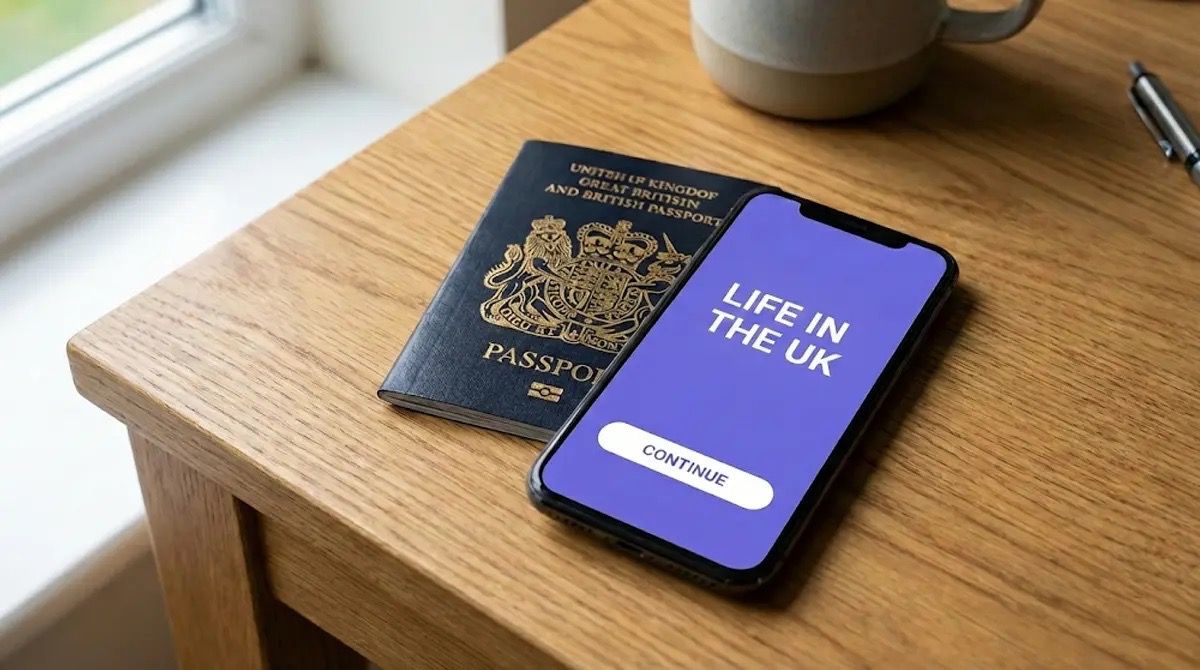
You must bring the same original ID you used to book the test — copies or screenshots are not accepted. If you booked using an eVisa, remember to write down or print your share code and bring it with you.

For the complete eVisa booking process, see our guide on Life in the UK Test eVisa Booking.
If you lack any of these documents, contact the Home Office before your test date. Arriving without proper identification means you will not be permitted to sit the test, and you will forfeit your £50 fee. For a complete checklist, see our guide on Life in the UK Test Booking.
A close-up of a British passport and a smartphone displaying a "Life in the UK" interface on a branded purple screen, symbolising readiness for the test centre requirements.
Empty space, drag to resize

Practical Tips for Test Day

Read each question carefully

Note whether it asks for one answer or multiple answers. Some questions include phrases like "Choose TWO correct answers" — missing this instruction is a common pitfall.

Trust your preparation

If you have studied from the official handbook, your first instinct is often correct. Second-guessing yourself can introduce errors.

Use the full time available

There is no bonus for finishing early. Review your answers, particularly questions where you felt uncertain.

Arrive early

Plan to reach the test centre at least 15 minutes before your appointment. This buffer reduces stress and allows time for check-in procedures.
Empty space, drag to resize

Key Takeaway

The Life in the UK test format is straightforward: 24 questions, 45 minutes, 75% pass mark. Understanding this structure removes uncertainty and allows you to focus your energy on what matters — learning the content. Calm preparation, not last-minute cramming, is your path to success.
Empty space, drag to resize

Your Next Steps

Ready to prepare with confidence? Our 20-Day Calm Sprint course takes you through the official handbook content in manageable daily sessions, designed specifically for busy professionals who want to pass without burning out. For those just beginning their research, return to our comprehensive Life in the UK Test 2026 — The Complete Calm Guide for the complete overview. You might also find our guides on Life in the UK Test Booking and Life in the UK Test Study Plan helpful as you plan your preparation journey.
Write your awesome label here.

FREE RESOURCE

Ready to start preparing?

Our 3-Day Starter Kit gives you:
Test format demystified
The most-tested British Values
Top 10 facts that appear in 80% of tests

About the creator

I'm Ricky — a digital learning experience designer with a background in UX and digital communications. Moving to a new country means navigating change on every front, and I've been through those transitions myself. I built this platform because I believe calm is a competitive advantage, and 'good enough' really is the new perfect. If you're preparing for the Life in the UK test while managing work and life, I know exactly what that feels like.

I know exactly what it's like to stare at 200+ pages of names, dates, and historical facts — wondering how anyone memorises all this while working full-time and managing real life.

The traditional approach felt all wrong to me: cram, panic, repeat. So I created something different.

This course is built on calm, structured learning — the same approach I used to pass first time. It respects your time, treats you like the capable adult you are, and focuses on what actually gets tested.

If I can pass calmly, so can you.

Ricky, creator — Embracing Imperfection Academy

Frequently Asked Questions

How many questions are on the Life in the UK test?

The Life in the UK test consists of 24 multiple-choice questions. You must answer at least 18 correctly (75%) to pass. Questions are drawn randomly from a bank covering British values, history, traditions, and government.

How long is the Life in the UK test?

You have 45 minutes to complete the test. Most candidates finish within 20–30 minutes, leaving time to review answers. The test is computer-based and taken at an approved test centre.

Is the Life in the UK test multiple choice?

Yes, all questions are multiple choice. Some questions require you to select one correct answer, whilst others ask you to select two or more correct answers. Always check how many answers each question requires.

What happens if I fail the Life in the UK test?

If you do not pass, you can retake the test as many times as needed. You must pay the £50 fee for each attempt and wait at least 7 days before rebooking. Your result is shown immediately on screen after completing the test.

Can I use a calculator or dictionary during the test?

No. You cannot bring any materials, devices, or aids into the test room. Mobile phones and bags must be stored in a locker. The test is designed to assess your knowledge without external assistance.

References

Created with