Dec 26 / Ricky Tam

Life in the UK Test 2026 — The Complete Calm Guide

Introduction

The Life in the UK test is a mandatory requirement for anyone seeking British citizenship or indefinite leave to remain. But here's what nobody tells you: this isn't an intelligence test. It's a memory test wrapped in anxiety, and that distinction matters. This guide exists because calm preparation beats frantic cramming.

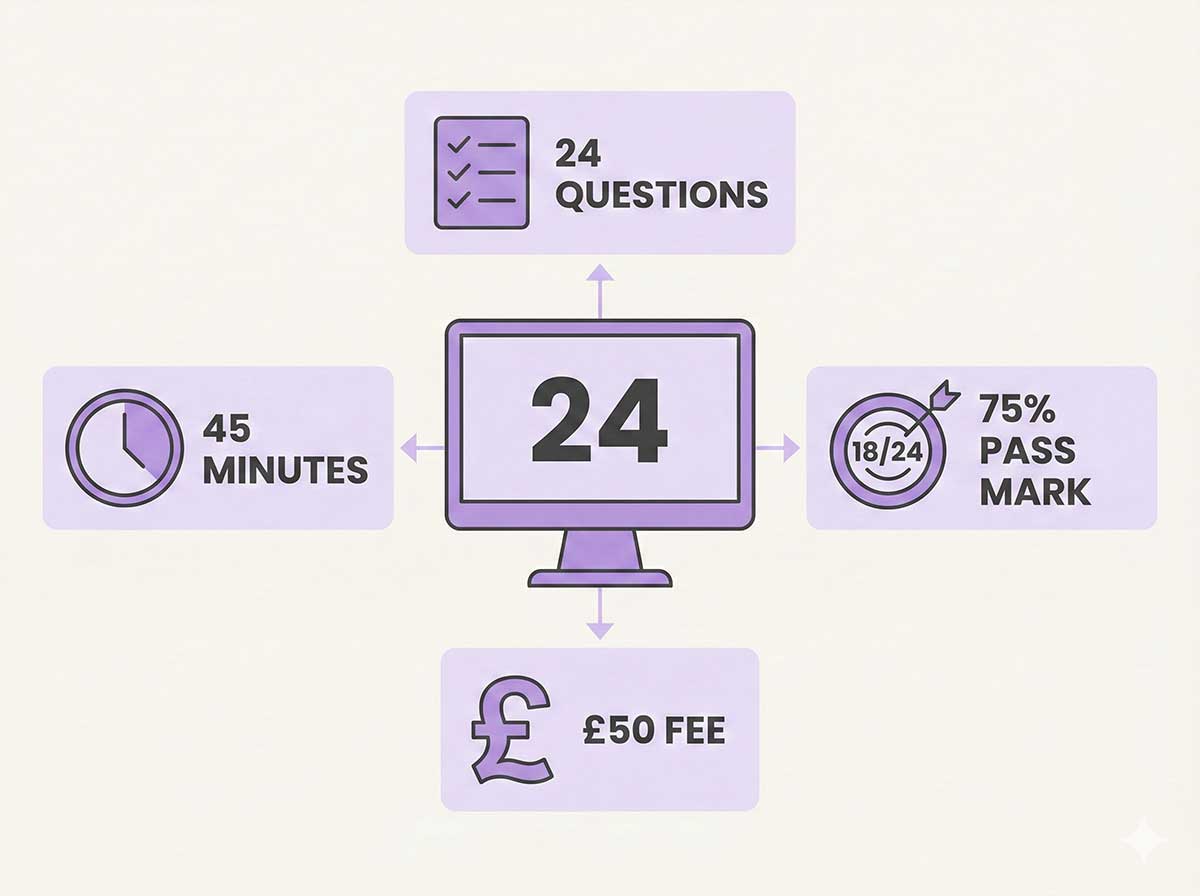
According to recent immigration law sources, approximately 75% of test-takers currently pass on their first attempt. Yet countless people approach this examination with unnecessary stress. They download dozens of apps, spend hours clicking through randomised questions, and arrive at the test centre exhausted rather than confident. The test itself hasn't changed dramatically — it remains 24 multiple-choice questions completed within 45 minutes. What needs to change is how you prepare.

This comprehensive guide walks you through everything you need to know about the Life in the UK test in 2026, from test format to calm preparation strategies. More importantly, it introduces you to a preparation framework that reduces anxiety whilst improving retention. Because the goal isn't just to pass — it's to pass calmly, confidently, and on your first attempt.

Study notes for Life in the UK test on organised desk with handbook and lavender
Empty space, drag to resize

Test Overview: Format, Timing, and Pass Rates

The Essential Facts

The Life in the UK test is a computer-based examination administered at over 30 authorised test centres across the United Kingdom. According to official guidance from GOV.UK, the test must be booked at least three days in advance and currently costs £50 for standard weekday appointments (up to £65 for peak or Sunday slots).

Test Format:

  • 24 multiple-choice questions
  • 45-minute time limit
  • Pass mark: 75% (at least 18 correct answers)
  • Computer-based with on-screen instructions

Test Result:

How you get your results can vary by centre. While official guidance says you'll be told verbally, many students (including me) receive a text message or email about 10 minutes after leaving.

Calm Tip:
Don’t worry if the test supervisor is silent. Keep your phone on once you’re outside; your result usually arrives digitally before you've even reached the bus stop. You can also log into your LitUK account to see the 'Pass' status and your Unique Reference Number (URN) immediately.
Life in the UK test format infographic showing 24 questions, 45 minutes, 75% pass mark, £50 fee

What You Need to Book:

  • Valid photo identification (passport, biometric residence permit, or UK photocard driving licence)
  • eVisa holders: Share code generated from your UKVI account
  • Email address and payment method
  • Choice of one of the five closest test centres to your postcode

The test must be booked through the official GOV.UK website only. Bookings made through unofficial sites are invalid.

Pass Rates: What the Statistics Tell Us

According to recent immigration law sources, approximately 75% of test-takers currently pass on their first attempt. Connaught Law reports that "recent Home Office data reveals a 75% overall pass rate," whilst other 2025 sources indicate pass rates remain in the 70-75% range. The Home Office no longer publishes detailed year-by-year statistics, but these current figures have remained relatively stable since the 2013 test format was introduced.

However, these aggregate statistics mask an important truth: pass rates vary dramatically based on factors within your control. Research on test preparation consistently shows that "preparation quality and study approach prove most significant factors determining success, with dedicated handbook review, practice test completion, and systematic content memorisation correlating strongly with first-attempt passes."
The distinction matters. Roughly one in four first-time test-takers fail not because the content is too difficult, but because their preparation approach increased anxiety rather than reducing it.

Booking with an eVisa

If you have an eVisa (digital immigration status that replaced physical BRP cards from 31st December 2024), you must generate a share code before booking your test. This is a common source of confusion for test-takers.

Brief Process:


For detailed step-by-step instructions with troubleshooting: See our complete guide: How to Book the Life in the UK Test with an eVisa
Empty space, drag to resize

FREE RESOURCE 

Ready to start preparing?


Our 3-Day Starter Kit gives you:

Test format demystified

The most-tested British Values

Top 10 facts that appear in 80% of tests

Empty space, drag to resize

What Makes This Test Difficult (And Why It Doesn't Have to Be)

The Three Hidden Challenges

1. Volume Without Context
The official Life in the United Kingdom: A Guide for New Residents (3rd Edition) contains hundreds of facts spanning British history, government structures, and cultural traditions. For many learners, absorbing this breadth of information presents a genuine challenge. Isolated facts can feel overwhelming because our brains naturally struggle to retain information without narrative connections. The challenge isn't the handbook itself — it's that humans learn better through stories and contexts than through lists and dates.

2. High-Stakes Anxiety
At £50 per attempt, plus the emotional weight of your settlement or citizenship application depending on this result, test anxiety is understandable. But here's the paradox: anxiety impairs the very cognitive functions you need for recall. When stressed, your prefrontal cortex — responsible for memory retrieval — becomes less effective.

3. Ineffective Preparation Methods
Most preparation apps use randomised question drilling. Whilst this tests existing knowledge, it does little to build new understanding. You're essentially gambling on which questions appear rather than systematically mastering content. This approach increases anxiety because you never know when you're "ready."

Why Calm Preparation Works Better

Research in cognitive psychology consistently demonstrates that spaced repetition, narrative learning, and anxiety reduction improve retention. When you understand why the Magna Carta matters (not just that it was signed in 1215), you remember it. When you learn British history as connected stories rather than isolated dates, your brain stores information more efficiently.

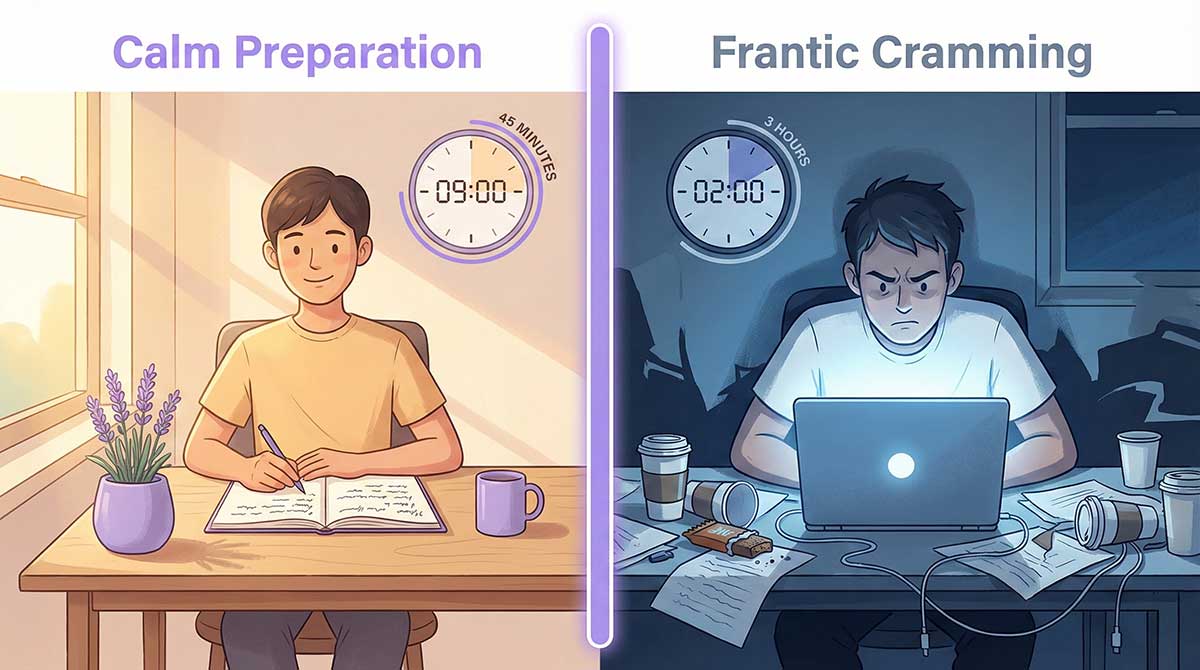
The calm approach doesn't mean casual or undisciplined. It means structured, systematic, and psychologically informed. It means understanding that 45 minutes of focused study daily outperforms three-hour cramming sessions. It means arriving at your test centre confident rather than frantic.
Comparison of calm preparation versus frantic cramming for Life in the UK test
Empty space, drag to resize

The Calm Preparation Framework

This framework forms the foundation of our 20-Day Calm Sprint methodology, but the principles apply to any structured preparation approach.

Principle 1: Work With Your Brain, Not Against It

Your brain learns best through:
  • Narrative structure: Stories stick better than lists
  • Spaced repetition: Reviewing content at increasing intervals (Day 1, Day 3, Day 7, Day 14)
  • Contextual understanding: Why events happened, not just when
  • Active retrieval: Testing yourself rather than passive reading

A structured 20-day programme that incorporates these principles dramatically outperforms months of random app-clicking. The key is consistency over intensity.

Principle 2: Create Finish Lines

Open-ended study creates anxiety. "I'll keep practising until I feel ready" means you never feel ready. Instead, set clear milestones:
  • Week 1: Foundation topics (British Values, Four Nations, government structure)
  • Week 2: Historical narrative (early Britain through 20th century)
  • Week 3: Integration and practice (everyday life, culture, mock tests)

This structure provides psychological security. You can see progress. You know when you're done. The endpoint isn't when you "feel ready" — it's when you've systematically covered all content and consistently score 85%+ on practice tests.

Principle 3: Reduce Test-Day Variables

Anxiety often stems from uncertainty. Remove as many variables as possible:
  • Visit your test centre location beforehand (if practical)
  • Know exactly which documents you're bringing
  • Plan your journey with a 30-minute buffer
  • Understand the on-screen interface through official practice materials
  • Get adequate sleep the night before (tired brains recall less efficiently)

For detailed test-day preparation: See our guide: 7 Common Mistakes That Fail the Life in the UK Test (And How to Avoid Them)
Empty space, drag to resize

Quick Start: Your First Week

If you're starting your preparation today, here's a practical first week to build momentum without overwhelm:

Days 1: Foundation & Orientation

  • Read the official handbook introduction
  • Understand the test format and pass requirements
  • Have an overview of how to book the test and generate a eVisa share code if needed

Days 2: British Values Deep Dive

British Values appear in almost every test version. Spend dedicated time understanding (not just memorising) these five principles:
  1. Democracy
  2. The Rule of Law
  3. Individual Liberty
  4. Mutual Respect
  5. Tolerance of Those with Different Faiths and Beliefs

For comprehensive British Values coverage with memory techniques: See Priority Topics to Master for the Life in the UK Test

Days 3: The Four Nations & Government Basics

  • Learn capitals, patron saints, national flowers for England, Scotland, Wales, Northern Ireland
  • Understand basic UK government structure (Parliament, Prime Minister, devolved governments)
  • Take your first practice test to establish baseline

Days 4-7: The Four Nations & Government Basics

  • Early British History: From the Celts to the Norman Conquest
  • The Middle Ages and the Rise of Parliament
  • The Tudors and the Reformation
  • The Stuarts, the Civil War, and the Bill of Rights

By the end of Week 1, you should feel oriented rather than overwhelmed. You understand what's required, how to booked the test, and you've covered the some of the most frequently tested topics.
Empty space, drag to resize

After You Pass: Understanding the Settlement Journey

Your Unique Reference Number

When you pass the Life in the UK test, you receive a unique reference number immediately. Store this securely — you'll need it for your indefinite leave to remain (ILR) or British citizenship application.

What Comes Next

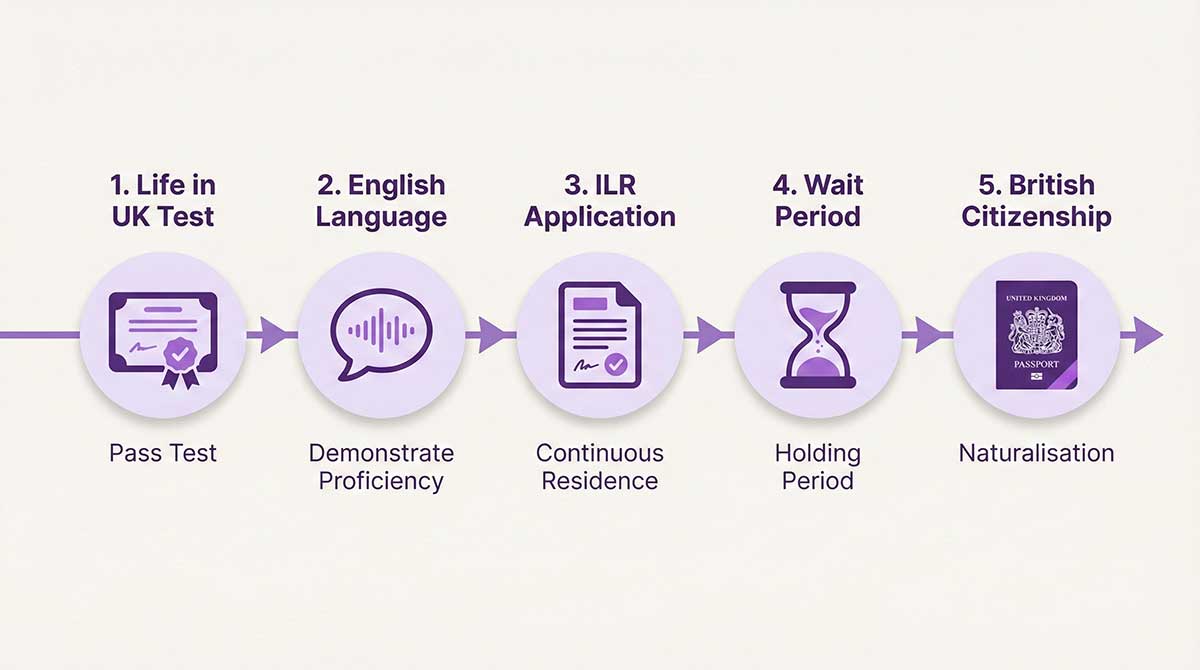
Passing the Life in the UK test fulfils one component of the "Knowledge of Language and Life in the UK" requirement. You must also demonstrate English language proficiency (unless exempt) and meet other eligibility criteria specific to your visa route.
Settlement pathway from Life in the UK test to British citizenship showing key stages

Important: Settlement Rules Are Changing

The UK Government announced significant proposed changes to settlement requirements in May 2025 and November 2025, including potential changes to qualifying residence periods, English language level requirements, and income thresholds. These proposals are under consultation and have not yet been implemented.

Be aware that as of January 2026, higher English language thresholds (B2) are being introduced for new work visa applicants, though the B1 requirement remains the standard for current routes leading to settlement.

Always check the official GOV.UK settlement guidance and British citizenship guidance for the most current requirements before planning your application timeline.
Immigration rules can change substantially, and what's accurate today may not reflect requirements when you're ready to apply.

General Settlement Pathway

Indefinite Leave to Remain (ILR):
Typically requires continuous residence in the UK for a specified period, meeting absence limits, demonstrating good character, and fulfilling language requirements.

British Citizenship:
Usually requires holding ILR for a period before applying, though routes vary (for example, spouses of British citizens have different requirements).

For your specific route and timeline, consult official GOV.UK guidance for your visa category or seek professional immigration advice.
Write your awesome label here.

FREE RESOURCE

Ready to start preparing?

Our 3-Day Starter Kit gives you:
Test format demystified
The most-tested British Values
Top 10 facts that appear in 80% of tests

About the creator

I'm Ricky — a digital learning experience designer with a background in UX and digital communications. Moving to a new country means navigating change on every front, and I've been through those transitions myself. I built this platform because I believe calm is a competitive advantage, and 'good enough' really is the new perfect. If you're preparing for the Life in the UK test while managing work and life, I know exactly what that feels like.

I know exactly what it's like to stare at 200+ pages of names, dates, and historical facts — wondering how anyone memorises all this while working full-time and managing real life.

The traditional approach felt all wrong to me: cram, panic, repeat. So I created something different.

This course is built on calm, structured learning — the same approach I used to pass first time. It respects your time, treats you like the capable adult you are, and focuses on what actually gets tested.

If I can pass calmly, so can you.

Ricky, creator — Embracing Imperfection Academy

Frequently Asked Questions

How difficult is the Life in the UK test?

The test requires thorough preparation but isn't designed to be impossible. With structured study, approximately 75% of test-takers pass on their first attempt. The difficulty lies in the volume of factual content, not the questions themselves.

Can I use study materials other than the official handbook?

Yes, supplementary resources can help, but all test questions are drawn exclusively from the official Life in the United Kingdom: A Guide for New Residents (3rd Edition). Your preparation should centre on this handbook's content.

What happens if I fail the test?

You can rebook after seven days. Each attempt costs £50. There's no limit on retakes, but thorough preparation significantly increases your chances of passing first time, saving both money and stress.

How long should I study?

Most people benefit from 2-4 weeks of structured daily study (45-60 minutes per day). Cramming the week before rarely works. Consistent, spaced practice over 3-4 weeks produces better retention and lower anxiety.

Do I need to memorise the entire handbook?

No. Whilst you should study all content, certain topics appear more frequently. Focus on British Values, key historical dates, government structure, and the Four Nations whilst ensuring you've covered everything at least once.

Continue Your Calm Preparation Journey

Ready to dive deeper? These detailed guides expand on specific aspects of test preparation:

Essential Guides:
How to Book the Life in the UK Test with an eVisa (2026 Guide)
Complete step-by-step instructions for generating your share code, booking your test, and understanding what to bring on test day. Includes troubleshooting for common eVisa issues.

Deep dive into British Values, high-frequency historical facts, government structure, and the Four Nations. Includes memory techniques for each topic area.

Master the questions that trip up most candidates — from confusing history dates and similar-sounding monarchs to multi-select traps and negative phrasing. Includes proven strategies for each challenge area.
Empty space, drag to resize

Take Your First Step: The 3-Day Starter Kit

Understanding the Life in the UK test is the first step. Preparing effectively is the next.

Our free 3-Day Starter Kit introduces you to the calm preparation method that helps hundreds of people pass first time. Over three days, you'll receive:

Day 1: Test format demystified — exactly what to expect, how questions work, and why you can get six questions wrong and still pass
Day 2: The British Values breakdown — memory techniques for the most-tested topic, delivered in a way that makes sense
Day 3: The Top 10 Facts — high-frequency content that appears in 80% of tests, with simple recall methods

Each day includes a printable PDF resource you can use throughout your preparation.
Empty space, drag to resize

Your Settlement Journey Begins With Calm

The Life in the UK test represents a significant milestone in your settlement or citizenship journey. It's a hurdle, certainly — but not an insurmountable one. Thousands of people pass each month, and with proper preparation, there's no reason you can't join them.

The difference between those who pass calmly on their first attempt and those who fail repeatedly often comes down to preparation method, not capability. Choose an approach that works with your brain's natural learning patterns. Structure your study. Reduce anxiety. Arrive confident.

You've already demonstrated remarkable determination by building a life in the United Kingdom. This test is simply the next step in making that life permanent.
Prepare well. Stay calm. Pass first time.
Empty space, drag to resize

References

Created with