Jan 20 / Ricky Tam

Life in the UK Test Study Plan: Your 20-Day Roadmap to Calm Confidence

Introduction

You have decided to take the Life in the UK test, but when you look at the official handbook — all 180 pages of British history, government, and culture — a familiar feeling surfaces. Where do you even begin? How much time do you need? And how do you fit preparation into an already full life of work, family, and the countless small demands that fill your days?

Here is the truth that experienced test-takers will tell you: success comes not from cramming harder, but from studying smarter. A structured study plan transforms an overwhelming task into manageable daily steps. Twenty days of calm, consistent preparation is worth more than a weekend of panicked memorisation.

A desk calendar with a date circled in purple, alongside a study planner and tea, representing a calm and planned approach to booking a Life in the UK test date.
Empty space, drag to resize

Why a Structured Plan Matters

The Life in the UK test covers five chapters of content spanning thousands of years of British history, the structure of government, cultural traditions, and everyday life. Without a plan, most people either study randomly — jumping between topics without building real understanding — or procrastinate until anxiety forces a last-minute cramming session.

Neither approach works well. Random study leaves gaps in your knowledge. Cramming creates short-term memory that fades under test pressure. What works is systematic coverage with built-in review cycles — exactly what a structured study plan provides.
A 20-day plan means roughly three weeks of preparation. This timeline works for most candidates: long enough to cover all content thoroughly, short enough to maintain momentum and avoid burnout. If your schedule is particularly demanding, you can extend to 25 or 30 days; the principles remain the same.
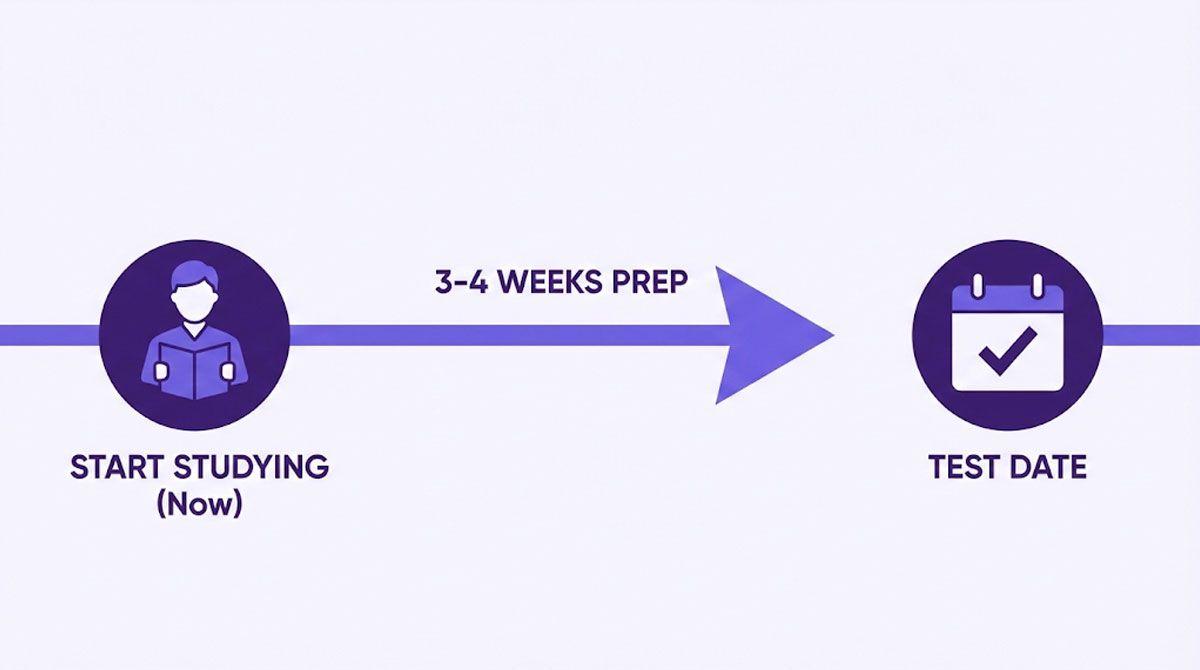
A minimalist timeline infographic illustrating the recommendation to book the Life in the UK test 3-4 weeks in advance to allow for sufficient study time.
Empty space, drag to resize

FREE RESOURCE 

Ready to start preparing?


Our 3-Day Starter Kit gives you:

Test format demystified

The most-tested British Values

Top 10 facts that appear in 80% of tests

Empty space, drag to resize

The Three-Phase Approach

Effective test preparation follows three distinct phases, each with a different purpose. Trying to do everything at once — reading, memorising, and testing simultaneously — creates confusion. Separating these phases brings clarity.
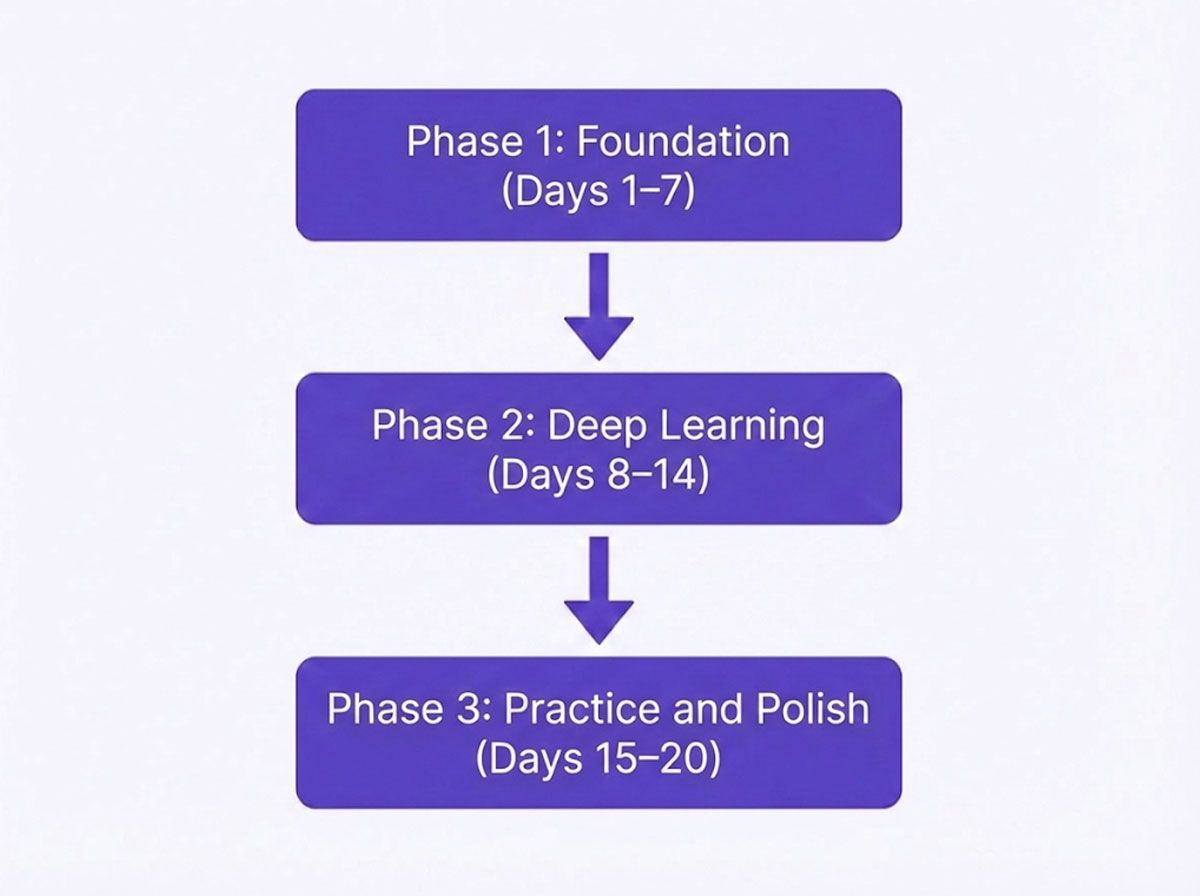
A simple flowchart infographic showing the three phases of an effective test preparation.

Phase 1: Foundation (Days 1–7)

Your first week is about exposure, not memorisation. Read through the entire official handbook at a comfortable pace, roughly one chapter per day plus buffer time. Do not try to remember everything — that comes later. Your goal is to understand the landscape: what topics exist, how they connect, and which areas feel familiar versus unfamiliar.
During this phase, take light notes on topics that seem important or confusing. Mark sections you will need to revisit. Notice which chapters feel longer or more complex — this tells you where to allocate extra time later.
Many candidates skip this foundation phase, diving straight into memorisation. This is a mistake. Without the big picture, individual facts float without context. With it, everything has a place to anchor.
For a complete breakdown of what each chapter covers, see our guide on Life in the UK Test Topics.

Phase 2: Deep Learning (Days 8–14)

Your second week is where real learning happens. Return to each chapter with focused attention, spending more time on content-heavy sections like British history. Use active study techniques: make flashcards for key dates and facts, create timelines for historical periods, test yourself frequently rather than simply re-reading.

Active recall — testing yourself on information rather than passively reviewing it — is the single most effective study technique research has identified. Each time you successfully retrieve a fact from memory, that memory becomes stronger. Each time you realise you have forgotten something, you know exactly what needs more attention.

During this phase, take your first practice tests. Do not worry about scores yet; use these tests to identify weak areas. If you consistently miss questions about Tudor history or the structure of Parliament, you know where to focus your remaining study time.

Phase 3: Practice and Polish (Days 15–20)

Your final phase is intensive practice testing. Aim to complete at least one full 24-question practice test daily, preferably two. Analyse your results carefully: which topics cause errors? Which question types trip you up?

By this phase, you should be consistently scoring 20 or above out of 24 — that is 83%, comfortably above the 75% pass mark. If you are not reaching this threshold, extend your study period rather than sitting the test unprepared. There is no shame in taking an extra week; there is frustration in failing and paying another £50.

For guidance on the questions that challenge most candidates, see our article on Life in the UK Test Difficult Questions.
Empty space, drag to resize

A Sample Daily Schedule

How does this translate into actual daily study? Here is a realistic schedule for someone with work and other commitments:

Days 1–7 (Foundation)

45–60 minutes daily. Read one chapter section, take brief notes, highlight unclear areas.

Days 8–14 (Deep Learning)

60–90 minutes daily. Review one major topic in depth, create study aids, take one short practice quiz.

Days 15–20 (Practice)

60–75 minutes daily. Complete one to two full practice tests, review all incorrect answers, light revision of weak areas.

Total time investment: approximately 20–25 hours across three weeks. This is achievable for most working professionals — roughly the equivalent of watching one television episode per day.
Empty space, drag to resize

Managing Your Energy, Not Just Your Time

A study plan is only useful if you actually follow it. This requires managing your energy as carefully as your time. Study when you are alert, not exhausted. If you are a morning person, study before work. If evenings suit you better, protect that time.
Build in rest days if needed. Missing one day will not derail your preparation; missing five days because you burned out will. The goal is sustainable progress, not heroic effort followed by collapse.
If anxiety is affecting your sleep or focus, address that alongside your study plan. Exhausted, anxious study is ineffective study. Our resources on test anxiety offer practical techniques for staying calm: Life in the UK Test Anxiety.
Empty space, drag to resize

What If Life Gets in the Way?

Life rarely cooperates with our plans. Work emergencies, family needs, illness — disruptions are normal, not failures. If you miss days, simply extend your timeline. A 25-day plan you complete is infinitely better than a 20-day plan you abandon.

Do not try to make up missed days by cramming double sessions. This leads to fatigue and diminishing returns. Instead, adjust your test booking date if needed. You can reschedule up to three days before your appointment without losing your fee.
Empty space, drag to resize

When You Are Ready

How do you know preparation is complete? When you consistently score 20–22 out of 24 across multiple different practice tests — not the same test repeated, but varied questions each time. This demonstrates genuine knowledge rather than pattern memorisation.
At this point, continuing to study often increases anxiety without improving results. Trust your preparation. Get a good night's sleep before your test. Do a light review in the morning if it helps your confidence, but avoid intensive last-minute cramming.

Calm Tip
: Aim for a consistent 90% (22/24) in three consecutive mock tests. This provides the "Anxiety Buffer" needed for the actual test day environment.

For details on what the test itself involves, review our guide on Life in the UK Test Format Explained.
Empty space, drag to resize

Key Takeaway

A structured 20-day study plan transforms overwhelming preparation into manageable daily steps. Three phases — foundation reading, deep learning, and practice testing — build genuine understanding rather than fragile memorisation. Aim for consistent scores of 83% or above before booking your test, and trust that calm, systematic preparation leads to calm, confident performance.
Empty space, drag to resize

Your Next Step

Ready to begin? Our 20-Day Calm Sprint course provides exactly this structure: daily lessons covering all handbook content, built-in practice tests, and progress tracking to keep you on pace. Designed for busy professionals, it ensures you arrive at your test centre feeling prepared, not panicked.

For the complete picture of your test journey, return to our comprehensive Life in the UK Test 2026 — The Complete Calm Guide.
Write your awesome label here.

FREE RESOURCE

Ready to start preparing?

Our 3-Day Starter Kit gives you:
Test format demystified
The most-tested British Values
Top 10 facts that appear in 80% of tests

About the creator

I'm Ricky — a digital learning experience designer with a background in UX and digital communications. Moving to a new country means navigating change on every front, and I've been through those transitions myself. I built this platform because I believe calm is a competitive advantage, and 'good enough' really is the new perfect. If you're preparing for the Life in the UK test while managing work and life, I know exactly what that feels like.

I know exactly what it's like to stare at 200+ pages of names, dates, and historical facts — wondering how anyone memorises all this while working full-time and managing real life.

The traditional approach felt all wrong to me: cram, panic, repeat. So I created something different.

This course is built on calm, structured learning — the same approach I used to pass first time. It respects your time, treats you like the capable adult you are, and focuses on what actually gets tested.

If I can pass calmly, so can you.

Ricky, creator — Embracing Imperfection Academy

Frequently Asked Questions

How long should I study for the Life in the UK test?

Most successful candidates spend 4–6 weeks preparing, dedicating 1–2 hours daily. A structured 20-day plan with consistent study is typically sufficient for thorough preparation. Cramming in a few days is not recommended.

What is the best way to study for the Life in the UK test?

Follow a phased approach: first read through all content (1 week), then deep-dive with active note-taking (1 week), then intensive practice tests (1 week), and finally light consolidation before test day. Focus extra time on history, which has the most questions.

How many practice tests should I take?

Take at least 10–15 full practice tests before your real exam. Daily practice tests during your final week of preparation help identify weak areas and build familiarity with question formats. Aim to consistently score 83%+ before booking your test.

Should I study the night before the test?

Light review is fine, but avoid intensive study the night before. Cramming can increase anxiety and fatigue. Trust your preparation, get a good night's sleep, and perhaps do one practice test in the morning if it helps your confidence.

What if I can't study every day?

Life happens. If you miss days, simply extend your timeline rather than cramming double sessions. A 25-day plan you actually complete is better than a 20-day plan abandoned halfway. Consistency matters more than intensity.

References

  • Dunlosky, J. et al. (2013). Improving Students’ Learning With Effective Learning Techniques. Psychological Science in the Public Interest. (Supports Spaced Repetition/Active Recall).
  • GOV.UK. (2026). Life in the UK Test.
    https://www.gov.uk/life-in-the-uk-test
  • Home Office. (2026). Life in the United Kingdom: A Guide for New Residents (3rd Edition). TSO.
  • Official Life in the UK Test Website. (2026). Official Study Guide.
    https://www.officiallifeintheuk.co.uk/shop
Created with